



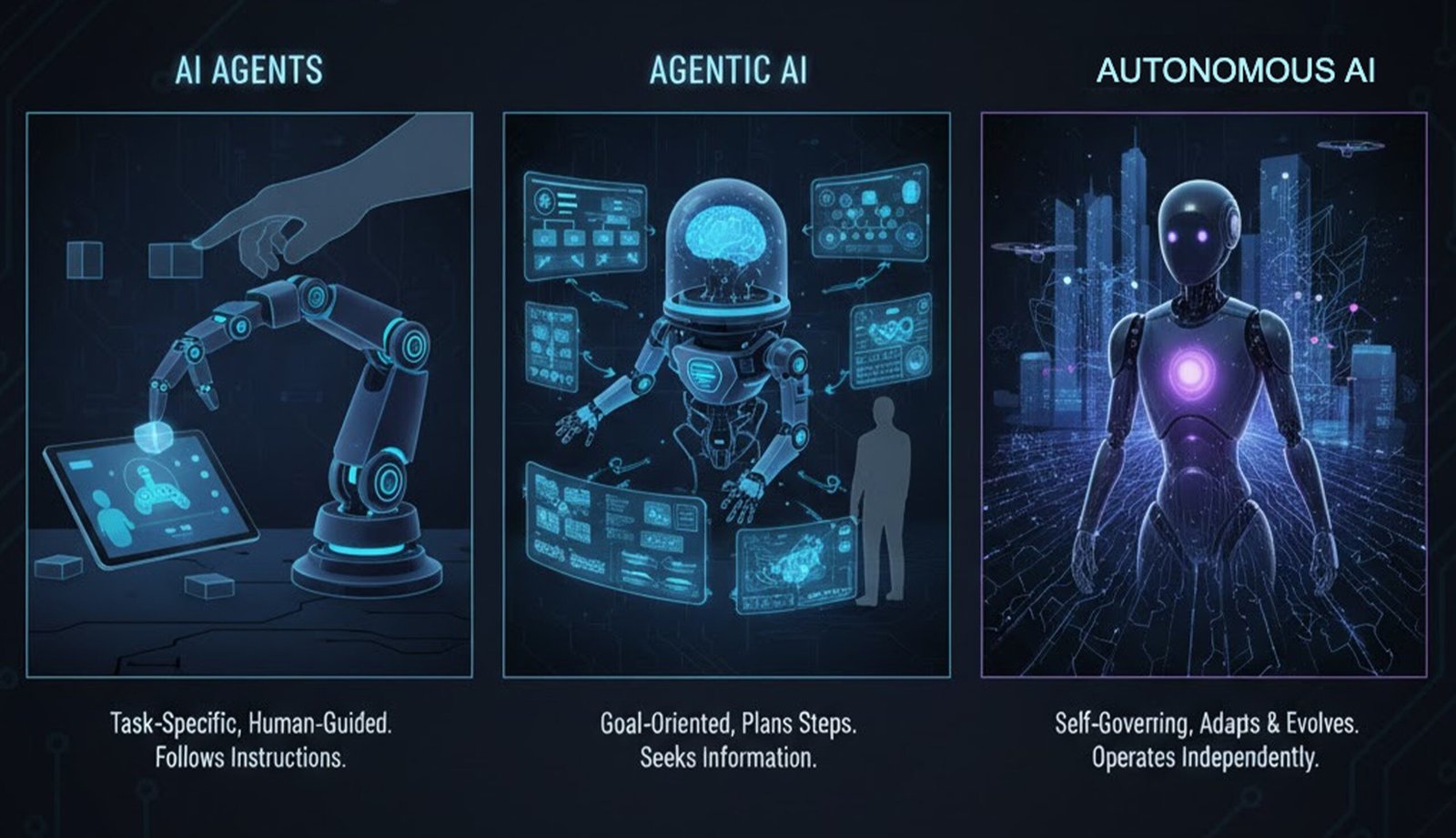
As static task-specific AI becomes an adaptive being capable of learning and making decisions, additional vocabulary can be used to describe its capabilities. Phrases like AI agents, agentic AI, and autonomous AI are thrown around interchangeably all the time, but are they so interchangeable?
These notions are related but correspond to different generations of intelligent systems. It is important to recognize the difference between them for designers, developers, policy-makers and anyone else interested in where AI technology is going.
| Key Takeaways: |
|---|
| AI Agents represent the foundational stage, performing predefined tasks within fixed rules and limited adaptability.Agentic AI bridges the gap by introducing planning, learning, and context-aware adaptability for more dynamic goal achievement.Autonomous AI embodies complete independence and is capable of self-initiated decision-making and long-term planning with minimal human oversight.The evolution from agents to autonomy marks a continuum of increasing intelligence, adaptability, and responsibility in AI systems.Building higher autonomy requires robust safety, transparency, and governance frameworks to balance power with accountability. |
AI Agent
An agent is defined as an autonomous system that perceives its environment and acts so as to meet its goals. It communicates with the environment through inputs and outputs. Agents can span from static rule-based bots to learned-automata style models, which optimize their actions over time. Their freedom is often restricted, and they perform limited actions based on predefined instructions.
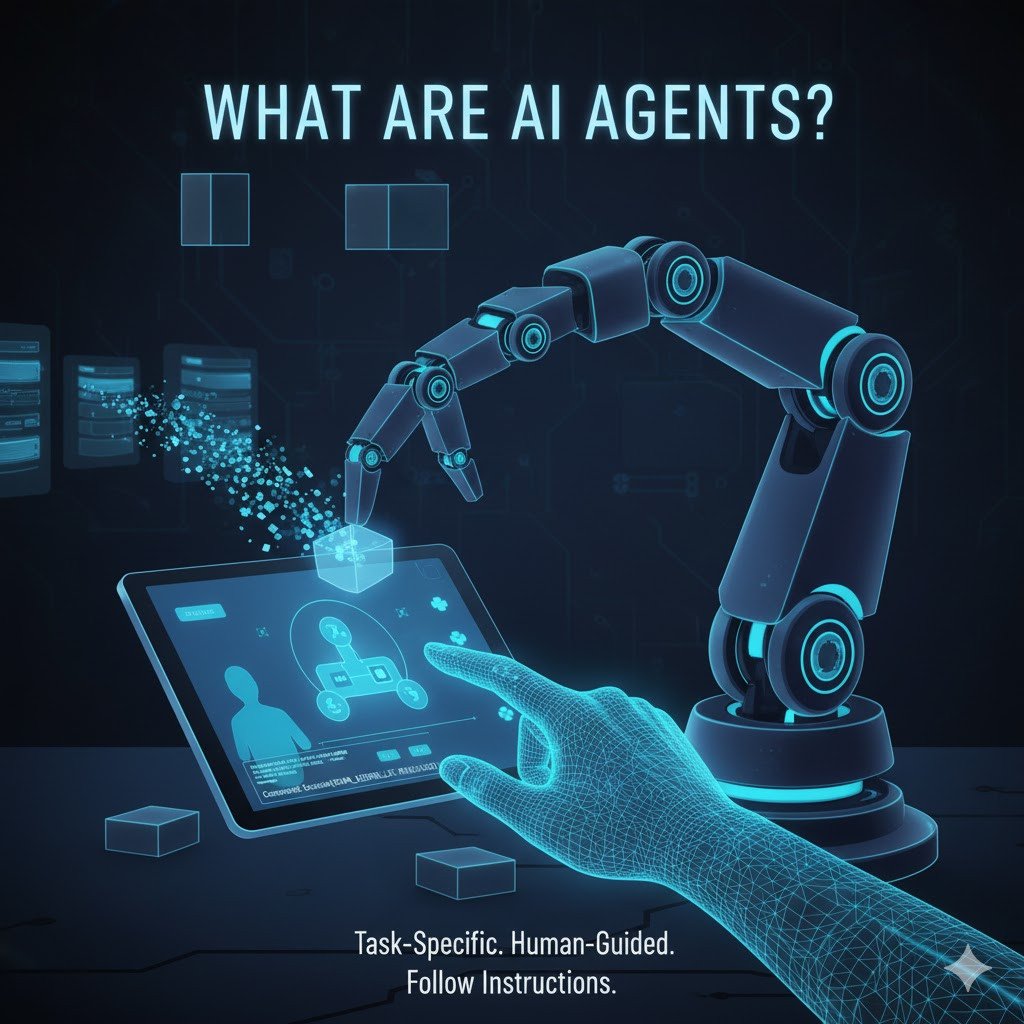
AI agents are the building blocks of intelligent systems. They are designed to perceive, decide, and act in ways that achieve predefined goals. An AI agent typically includes:
- Perception: The system takes inputs from the environment (sensors, APIs, text, images, logs) and extracts meaningful signals/features. Effective perception filters out noise and maintains context for decision making.
- Decision Logic: The system decides the most suitable next move based on current state and objectives through rules, learned policies, search/planning, or optimization. It can also predict uncertainty and trade-offs.
- Action: The system performs the selected action-commanding, updating data, moving a robot, responding to a user, and then monitors the effects. Those results swim right back up into perception for the next cycle.
These actions create a feedback cycle: sense → decide → act → repeat. The loop permits the agent to engage in lifelong interaction with its environment.
Types of AI Agents
AI agents exist along a spectrum of complexity:
- Simple Rule-based Agents: These agents follow a particular set of logic and conditions, and in general, they act only when certain rules are satisfied. For instance, “if the temperature > 30°C, enable the cooling system”.
- Model-based Agents: Construct and update models of the environment and use these models to make good decisions.
- Learning Agents: Continually get better by applying reinforcement or supervised learning to adjust behavior according to feedback and experience.
- Goal-based Agents: Decide by searching for and executing actions that take them closer to predefined goals or desired final outcomes.
- Utility-based Agents: Assess various possible scenarios and choose the one that yields the highest degree of global satisfaction (utility), trading off between disparate goals.
Practical Examples
- Chatbots: Engage with users in everyday language, answering questions and doing menial tasks within specific domains or contexts.
- Recommendation Engines: Study user behavior and preferences so that customized products or selections, including movies and articles, can be recommended.
- Bots: Responsible for watching market data and executing buy or sell orders based on your settings or strategies.
- Game Agents: Serve as simulated players and opponents, moving pieces, and making choices in what appear to be smart playing behaviors.
While capable, these agents are generally reactive and constrained within the environments they were designed for.
Strengths and Limitations
| Advantages | Limitations |
|---|---|
| Reliable in predictable environments.Easy to test and maintain.Ideal for repetitive or well-defined tasks. | Struggle with ambiguity or new situations.Limited adaptability without retraining.Require human oversight for complex decision-making. |
AI agents are excellent doers, but not thinkers. Their lack of ability to adapt in real-time to differing circumstances is what spawned agentic AI.
Agentic AI
Agentic AI refers to the whole ecosystem or environment that does more than just act, reason, adapt, and plan across multiple steps. It is characterized by agency, that is, they can make decisions in a context-sensitive manner, can follow sub-goals or can change strategies dynamically. Agentic AI isn’t quite autonomous in the absolute sense, but it demonstrates self-directed behavior, planning and learning, a midpoint between simple agents and truly autonomous intelligence.
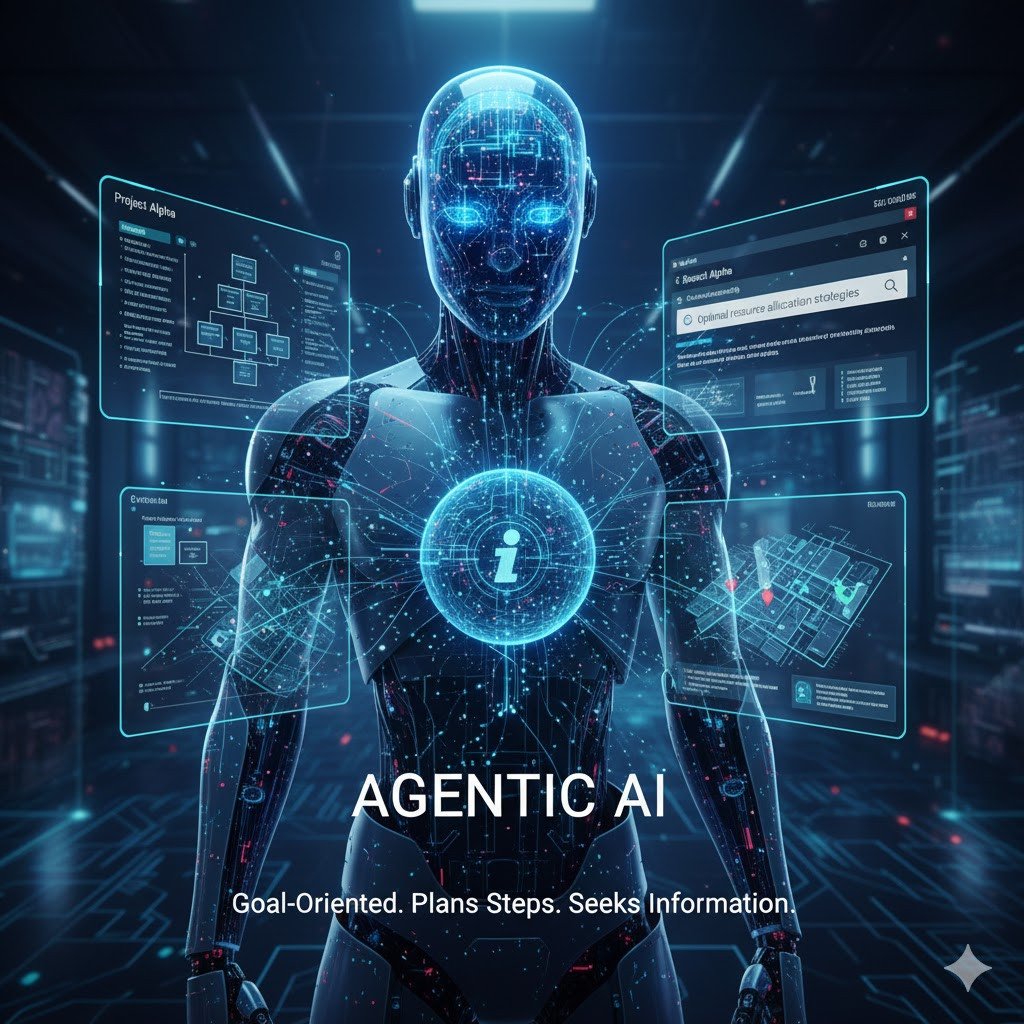
Agentic AI: The Adaptive Middle Ground
Agentic AI is the next phase of that evolution, systems capable of not just planning, adapting, and collaborating but working to accomplish things. They have characteristics such as self-control and attention to context, which make them similar to humanlike agents.
What Makes AI “Agentic”?
An AI becomes agentic when it can:
- Decompose Complex Goals: An agentic AI can divide up a big goal into smaller tasks that it can complete more easily, handling problems in an efficient step-by-step way.
- Adapt its Plan: Change its tactics when new information or unforeseen factors force it to, thereby making it adaptable.
- Learn from Experience and Feedback: The system learns better scenario selection over time by observing outcomes and previously taken actions.
- Coordinate with the Actions of Others: It works well with other AI systems and people, exchanging information and coordinating their efforts toward common ends.
- Predict and Trade-off: The AI models evaluate the effects of its own actions, weighing risk versus reward and priorities with respect to improving overall performance.
Example: Agentic Workflow Automation
Imagine an AI system managing a company’s marketing campaign. The system:
- Defines goals (increase engagement).
- Deconstructs them (running ads, analyzing results, and budget optimization).
- Manages specialized sub-agents (content creation, analytics, ad placement).
- Automates monitoring metrics, tuning campaigns, and refocusing strategies automatically.
Here, AI isn’t merely reacting; it’s thinking and methodically moving its way through the process dynamically.
Strengths and Limitations
| Advantages | Limitations |
|---|---|
| Handles complexity and changes gracefully.Can recover from unexpected outcomes through self-correction.Reduces the need for constant human management. | Decision-making can be hard to interpret.Multi-agent orchestration can cause conflicts.Balancing autonomy with oversight is delicate. |
Autonomous AI
Fully autonomous AI is the greatest degree of independence. These systems can scale to complex, open-ended tasks without the need for constant human supervision. They are thinking, rational beings that make decisions on the fly when confronted with unknown situations in a relatively unsupervised way. The thing autonomous AI aims to do is simulate human-like decision-making and flexibility, potentially working around the clock in changing environments.
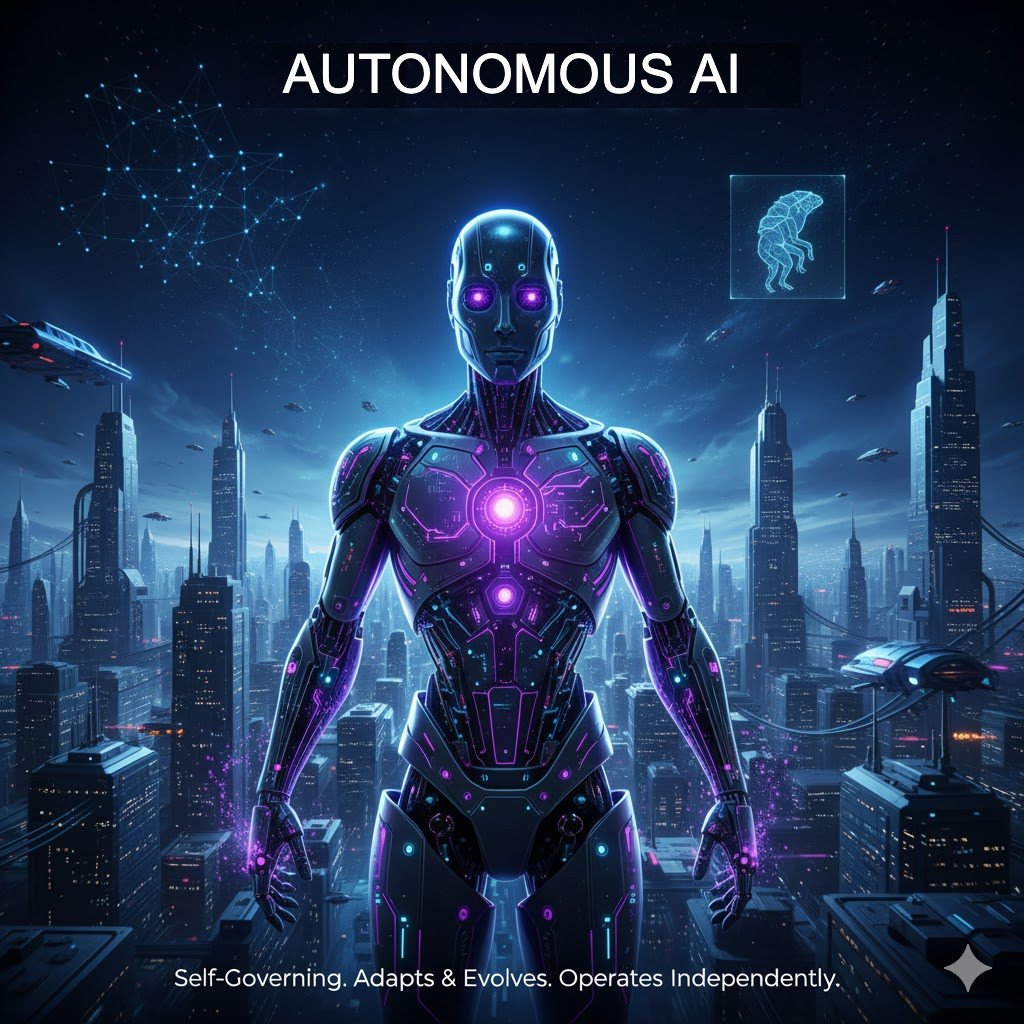
Autonomous AI: The Peak of Independence
Autonomous AI is the most advanced form of artificial intelligence, systems that can operate independently in complex and unpredictable environments. An AI is called autonomous if it is able to establish and pursue its own goals, work with little or no human assistance, be able to act safely in the presence of unexpected conditions, and plan and react over long time periods.
These systems combine perception, reasoning, and action in a continuous feedback loop that allows them to be flexible in response to the particular variations of their environment while remaining responsible and accountable.
Key Features
- Self-Initiation: The system initiates tasks on its own or creates new goals without requiring specific human requests, and with more proactive behavior.
- Adaptation to Novelty: It is intelligent in its response to a new stimulus or task by making an abstraction from past experience and changing its strategy of action.
- Long-term Planning: The AI takes a look at what the future holds and how it will result from its current activity, delivering and enacting plans that have time as one of the dimensions and conditions change.
- Minimal Oversight: It works well without human input and operates autonomously, ensuring a high level of consistency and accountability.
- Integrated Reasoning: The platform inherently combines perception, prediction, and decision-making for context-aware interpretation and intelligent response.
Levels of Autonomy
Just as autonomous cars are rated on a scale from Level 0 (manual) to Level 5 (fully autonomous), AI is classified according to where it falls along the spectrum of autonomy:
- Level 1 – Human-assisted: AI supports humans to automate certain tasks, but is not able to make decisions by itself, as it requires human control and input directly.
- Level 2 – Human-supervised Automation: The system is capable of some independent operation; however, humans are always on hand to monitor it and can override if needed.
- Level 3 – Conditional Automation: The AI can act alone for long stretches but might ask a person to intervene, or take charge in tricky or uncertain situations.
- Level 4 – Fully Self-Driving in Various Limited Scenarios: The system can operate all functions unaided, but only under very specific circumstances or limited environments and as needed (some may not even need a human behind the wheel).
- Level 5 – Omniscient Through any Domain or Task: The AI is completely self-sufficient and can adjust itself on any occasion without human intervention.
Most real-world AI systems currently operate at Levels 2-3.
Example: Autonomous Research AI
Take a scientific AI tasked with discovering new chemical compounds. It develops theories and experiments to prove them, reviews the results, and refines its knowledge in response. It operates without micromanagement by humans, running autonomously to test ideas, learn from each experiment, and hone its strategies for directing future research. This is the sign of a would-be Cinderella, an AI that is persistent, goal-driven, and continually getting better as it seeks ever greater understanding.
Strengths and Limitations
| Advantages | Limitations |
|---|---|
| High scalability and productivity.Operates continuously without fatigue.Handles large-scale, complex systems beyond human capability. | The system might optimize for unintended objectives.Harder to explain decisions or failures.Mistakes can have real-world consequences. |
Spectrum and Hierarchical Perspectives
AI agents, agentic AI, and autonomous AI are not distinct categories as much as they form a continuum. Understanding this spectrum and the hierarchies among them clarifies how capabilities, autonomy, and responsibility evolve in systems.
The Autonomy Spectrum
The relationship between AI agents, agentic AI, and autonomous AI can be viewed as an ongoing sequence or evolution. Each type is more sophisticated than the previous in that each involves higher levels of capability, adaptability, and independence.
So each phase has what the previous one has: adaptiveness, autonomy, and long-term reasoning.
- AI agents: These are task-driven, low-backbone executors that work within a certain scope based on pre-determined rules or shallow learning.
- Agentic AI: Such systems also have the capability to adjust mission plans, coordinate with team members, and together manage flexible workflows.
- Autonomous AI: Follows decision-making over long horizons, executes plans, and goal-seeks with limited or no human integration.
No sharp line divides these stages; systems can possess mixed traits depending on design.
Organizational Analogy
Imagine an organization:
- AI Agents: Much like employees, agents concentrate on performing the task as instructed, with clear directives and a set of procedures in place.
- Agentic AI: Like middle managers, they decide and delegate tasks, monitor progress, and respond to problems.
- Autonomous AI: Acting like upper management, they establish top-level policy and strategy, but delegate day-to-day decision-making to distributed system elements.
This analogy captures the functional hierarchy and the degree of responsibility each stage represents.
Multidimensional Comparison
| Dimension | AI Agents | Agentic AI | Autonomous AI |
|---|---|---|---|
| Goal Scope | Single, fixed task | Multiple adaptive goals | Broad, evolving objectives |
| Learning | Limited or offline | Continuous adaptation | Self-directed learning |
| Planning Depth | Reactive | Multi-step planning | Long-horizon reasoning |
| Human Oversight | High | Moderate | Minimal |
| Coordination | Simple | Multi-agent collaboration | Ecosystem integration |
| Failure Handling | Manual reset | Self-correction | Autonomous recovery |
| Transparency | High | Medium | Low |
This table emphasizes that autonomy evolves along several dimensions, not just independence, but also adaptability, coordination, and decision depth.
